Featured

SMART Goals

Specific

My goal is to reduce my anxiety and stress levels through implementation of time management techniques and improved lifestyle choices. I choose this goal as I was struggling during the previous trimester and saw high anxiety and stress when assignments or examinations were approaching. I assessed that it could be due to my lack of time management practice, leading me to procrastinate and resulted in my bad state of mental health. Therefore, this implementation would help me to avoid the stress of last minute cramming and also benefit me through my lifestyle choices and habits.

Measurable

I will be using the 10 item Perceived Stress Scale (PSS)(Cohen et al., 1988) to measure my stress levels on a weekly basis. The PPS is a widely used and validated psychological scale that measures perceived stress. Its scoring ranges from 0 to 40 with higher values indicating higher perceived stress. The questions are designed to determine individuals feelings through their current levels of experienced stress. A personal reflection record will be kept for self-evaluation and reflection on anxiety levels and situations. This helps to determine if my time management options put into place assisted in maintaining or reducing stress and anxiety levels.

Achievable

My goal will be challenging as I would have to implement a time management system, which would require determination, persistence and good time management skills to stick to. However, as these are small and gradual changes, I believe that over the 4 weeks of implementation it would be feasible and attainable as this would benefit me even after the study and would help with my future habits and lifestyle choices. Also having 1 more year in university and am determined to be able to overcome my stress and anxiety. Therefore, I have the confidence in myself to attain this goal.

Realistic

Given the short timeframe of 4 weeks, alterations need to be kept to a minimal due to the limited timeframe. Therefore, sufficient research has to be done to determine a suitable, clear and effective plan for myself to meet my goal of reducing stress and anxiety. Furthermore, coming up with a consistent time management plan would help to reduce last minute cramming and help with ease in knowing when I should be studying and when I am able to take a break. This would allow me to reduce any overwhelming feelings and minimise any panic attacks that comes with deadlines.

Time

A program sheet for 7 days will be created to be used for the 4 weeks. Every Sunday of the week, this sheet will be altered/adjusted to base on the following week’s assignments and schedule. This will allow me to designate time for relaxation and other commitments between study times. Study time per day would be minimum of 2 hours and gradually increase due to more work load over the course of 4 weeks. This would allow myself to spread work out evenly and be able to meet due days ahead of time. The program sheet would be assessed weekly for being effective in helping evenly allocating time between studies for relaxation and being effective in reducing stress levels with ever changing schedules. Milestone achieves would be being up to date on lectures, tutorials and finishing assignments by end of week 8.
Week 4

The final week’s implementation was very similar to week 3. I found that the tactic of putting away my phone whilst studying to be very effective in relation to the productivity levels in my time management. I was easily sticking to the study plan with barely any issues. 

This week was to be a very busy week for me and I had to put in more hours to study in order to meet to my quiz and assignment deadlines. Typically, I would be very stressed and would have increased anxiety when assignment datelines are approaching as I would have left them to the last minute. However,  despite the increased number of studying hours this week, I found myself to be completely focused and hardly got frustrated at myself as I was progressing efficiently with my work. I believe this was due to the previous three weeks implementation, as I was up to date with my work having spread out my load over many days.

My PSS scores had decreased further and was at an all time low of 14 points. I was thrilled as I felt in control of my stress and anxiety, I was able to be calm and collected even under the pressure of deadlines and was able to meet to them. I will definitely be continuing with this system as I see the effectiveness of the strategy in my own studying patterns and have experienced positive results from it.

Week 3

Due to spotting flaws in my plan last week, of how my phone was causing a distraction in my studies. Over the week I did some research, and found some studies that backed up this issue. In a research study on how phone’s affect student learning (Kuznekoff,J. et al. 2013), it found that students who used their found frequently during video lectures would score an average 13 points or a letter grade lower that those who did not, and their overall note taking was 62% lower. 

Therefore, I decided to implement a change in my system , whereby I would keep my phone in my drawer whilst studying and would only be able to take it out to use for 15 mins during in between study breaks. Also rather than using a timer on my phone, I shifted my timer to my computer to allow me to not have to refer to my phone to see how long I had studied for to be able to take my break. 

My time management skills greatly improved this week, this is apparent significantly after I implemented the method above through the week. I was less distracted from wanting to use my phone as it was no longer in sight whilst I studied, I was more productive and had higher concentration levels, My PSS scores (See appendix 9), had a 5 points drop from week 2, and was much lower than my PSS control scores, signifying that the programme was having positive effects on my stress and anxiety level. I believe that I am on the right track and the downward trend continues.

Week 2

This week went much smoother as compared to week 1. I was able to keep to my time schedule more efficiently, especially during the first two days, this was probably due to my mid-week quiz. It motivated me to study as I had trouble understanding the topics which the quiz was on. I was able to have better control on meeting the 15 minutes breaks limit, however, I found that I was not able to concentrate with my phone next to me as I would be constantly checking it whilst studying and it was serving as a form of temptation to pull me away from work. 

Though I was still struggling with stress from the family issues occurring, which affected my mood and my motivation to study, I was determined to keep to my study plan as I saw the benefits from last week. I knew that I had the capabilities to keep to the plan and wanted to reap from the benefits that came with it. I also wanted to prove to myself at the end of the week that I was able to achieve this. 

My PPS scores came back lower than week 1, 4 points down. I believe that it was due to myself slowing adjusting and getting used to the study schedule, also I believe that daily study plans allowed me to have a constant yet gradual learning process that allowed me to take things once at a time. This greatly helped me though the week as I had lower levels of stress and anxiety with my daily school work.

Overall, I feel inspired to stick with the schedule plan for the following weeks and hope to see further improvements with my stress and anxiety levels.

Week 1

Overall, week 1 was implemented successfully. Though there was quite a few hiccups, I did accomplish my tasks for the week and managed to study for 5 days in the week. I also tried to keep stress and anxiety levels to the minimum. I was able to keep up to date on my homework and revision for my accounting module as well as kept up to date on lectures for this course.

However, I realised that I was not able to keep to the 15 minutes break rule and sometimes went over the amount. Though, I was able to finish my task when I returned back to studying without much distractions. I did have a sense of accomplishment after looking back at what I was able to achieve with the little time I used over the week and realised how much more I usually procrastinate if I did not plan my schedule.

I did start out the week feeling rather motivated, however, due to having received some bad news back from home as well as receiving not too good results on a previous accounting quiz, I lost some motivation to studying and was reluctant to follow the study plan. This added on to my stress levels as I didn’t want to fail so easily, having only started the programme.

My PPS scores came back higher than my control week’s result, I was saddened by this but also realised that it was due to I stressing over what was happening back a home. This led to I worrying that my affected mood would affect I following the study plan and led to a cycle of worrying. However, I would like to try again next week to give the study plan a chance.

Reduction of Stress and Anxiety through Application of Time Management

Strategy and Justification

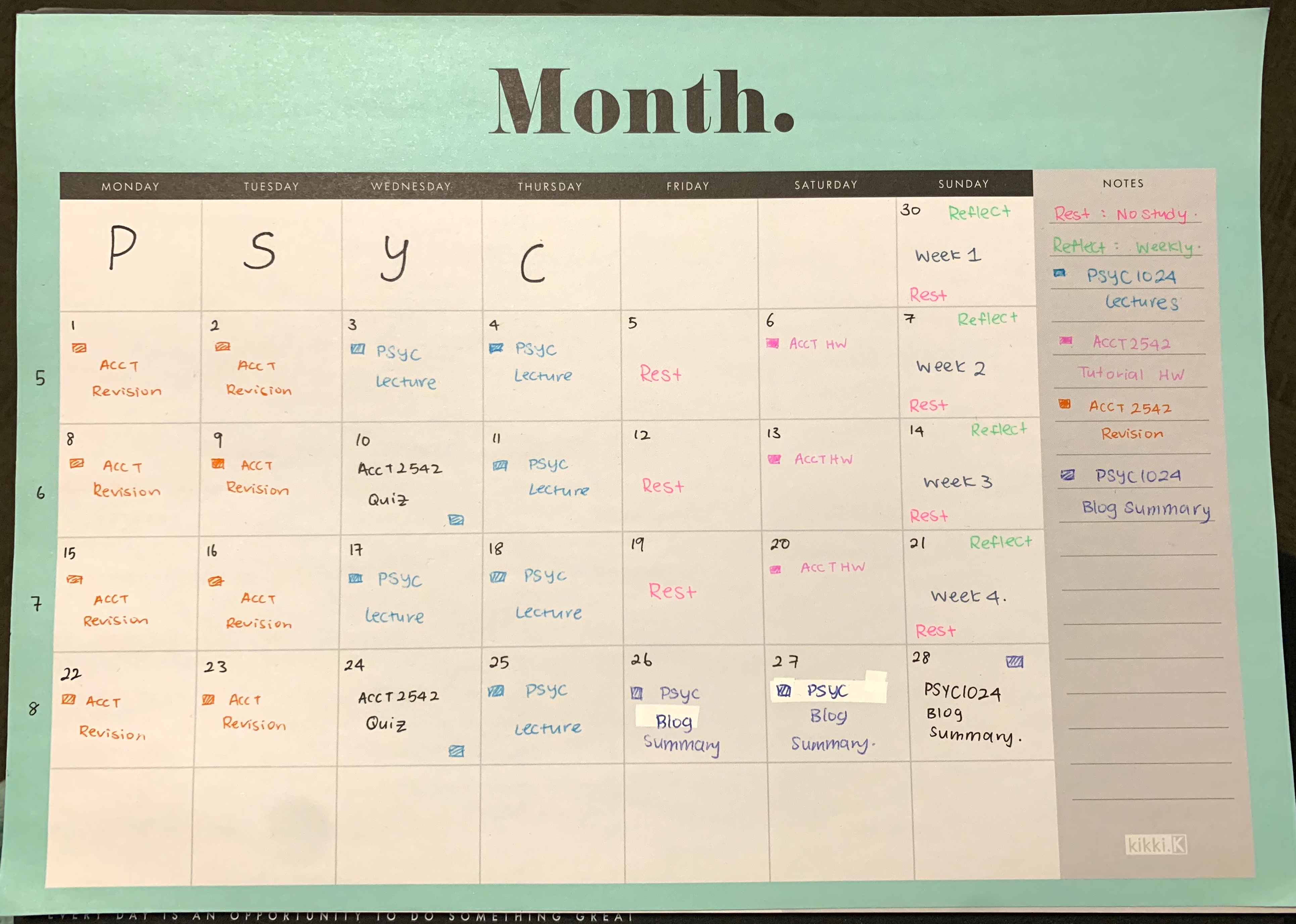
In order to achieve my goal of reducing stress and anxiety levels during study periods, a month view time schedule would be planned out to allow specific planning around assignments. A weekly program sheet, that would specify my daily schedule, would be made and followed. Weekly input through the Perceived Stress Scale (PSS)(Cohen, S. et al., 1988), would help to determine whether these time management measures put into place are benefitting in reducing my stress and anxiety levels. 

Studies have shown that having schedules that allocate specific time for studying, relaxation etcetera, is a beneficial strategy to coping with academic stress. Through a time management training programme, 23 university undergraduates found that their perceived stress decreased and perceived control of time increased. They found time management beneficial for their mental health’s well-being (Hafner, A. & Stock, A. & Oberst,V. 2014). In a 165 university undergraduates questionnaire research (Macan,T. & Shani,C. & Dipboye,R. & Phillips,A. 1990), findings from the research showed that there was significant correlations between time management behaviours, such as scheduling and planning, and perceived control of time, stress, anxiety and performance. Results showed that students who were applying time management tools more regularly had higher self-reported performance and greater satisfaction.

When applying my weekly program sheet, I will identify tasks and rank them based on their priority and urgency, followed by allocating time to the tasks. For example, in week 8 completion of the blog summary would be my top priority. Doing so would allow me to reduce my level of stress and anxiety as important tasks are being held above other tasks. Evidence from multiple researches show that setting activities, even essential tasks, based on priority result in positive effects on stress. Setting Priorities also has significant correlation with self-reported performance, whereby, students who set priorities resulted in having lesser stress than those who did not (Macan,T. et al. 1990, p.764). Evidence prove that effective time management would help me to stay on track with my studies and would also enable me to have adequate rest and recreation. This would benefit me in my stress and anxiety levels, leading to a healthier lifestyle and habits.

Another tool that I would be using, but updating to match my needs, would be the Pomodoro technique (Cirillo, F. 2006). This technique is a timeboxing method that helps in splitting large tasks into manageable bite sizes in order to reduce the feeling of being overwhelm or not knowing where to start. This planning, execution and reflection technique, will be most applicable in my studies, as there has been results where people experienced greater levels of concentration through the application of Pomodoro technique. In my application however, I will be using a different time method of 45- 60 minutes study sessions with 15 minutes breaks in between. This would go hand in hand with a total minimum 2 hours study per day with the exception of Sundays and Fridays. This is due to personal commitments on this two days, therefore they will be considered rest days. A daily reflections system would then be implemented to record my feelings on this method.

Materials List

  • Weekly Time Sheet
  • Month View Program Sheet/Calendar
  • Perceived Stress Scale (PSS)(Cohen et al., 1988)
  • Timer
  • Weekly Reflection

Strategy Methods

In order to implement this strategy, I have set up a month view program sheet as a basic guideline to plan my weekly time sheets over the course of four weeks. An average of 2 hour study sessions with 15 minutes breaks between each hour will be completed from 9am to 11 am daily, with the exception of Fridays and Sundays being my rest days. This would be adjusted based on workload for each week. 

In week 1, I would be focusing on fulfilling my SMART goals and keeping up on lectures for the week. In week 2, I would be putting focus on revision for a mid-week quiz I have for an accounting module I am taking. During week 3, I would shift back to ensuring I am up to date on tutorials and lectures. On week 4, I would be putting focus on both my blog summary and another mid-week test for my accounting module. Week 3 and 4 may require me to be putting in more hours in order to ensure that I maintain my low level of stress and anxiety to be meeting my due dates on time. 

Every Sunday of the week, I would be filling out the Perceived Stress Scale as well as recording down a reflection for the week, this would allow me to easily track my progress in terms of my stress and anxiety levels, and would allow easy comparison between each weeks. It would also allow me to reflect on whether I was able to follow my planned schedules, whether anything could be improved or adjusted or if there were any unforeseen circumstances.

Design a site like this with WordPress.com
Get started