Strategy and Justification
In order to achieve my goal of reducing stress and anxiety levels during study periods, a month view time schedule would be planned out to allow specific planning around assignments. A weekly program sheet, that would specify my daily schedule, would be made and followed. Weekly input through the Perceived Stress Scale (PSS)(Cohen, S. et al., 1988), would help to determine whether these time management measures put into place are benefitting in reducing my stress and anxiety levels.
Studies have shown that having schedules that allocate specific time for studying, relaxation etcetera, is a beneficial strategy to coping with academic stress. Through a time management training programme, 23 university undergraduates found that their perceived stress decreased and perceived control of time increased. They found time management beneficial for their mental health’s well-being (Hafner, A. & Stock, A. & Oberst,V. 2014). In a 165 university undergraduates questionnaire research (Macan,T. & Shani,C. & Dipboye,R. & Phillips,A. 1990), findings from the research showed that there was significant correlations between time management behaviours, such as scheduling and planning, and perceived control of time, stress, anxiety and performance. Results showed that students who were applying time management tools more regularly had higher self-reported performance and greater satisfaction.
When applying my weekly program sheet, I will identify tasks and rank them based on their priority and urgency, followed by allocating time to the tasks. For example, in week 8 completion of the blog summary would be my top priority. Doing so would allow me to reduce my level of stress and anxiety as important tasks are being held above other tasks. Evidence from multiple researches show that setting activities, even essential tasks, based on priority result in positive effects on stress. Setting Priorities also has significant correlation with self-reported performance, whereby, students who set priorities resulted in having lesser stress than those who did not (Macan,T. et al. 1990, p.764). Evidence prove that effective time management would help me to stay on track with my studies and would also enable me to have adequate rest and recreation. This would benefit me in my stress and anxiety levels, leading to a healthier lifestyle and habits.
Another tool that I would be using, but updating to match my needs, would be the Pomodoro technique (Cirillo, F. 2006). This technique is a timeboxing method that helps in splitting large tasks into manageable bite sizes in order to reduce the feeling of being overwhelm or not knowing where to start. This planning, execution and reflection technique, will be most applicable in my studies, as there has been results where people experienced greater levels of concentration through the application of Pomodoro technique. In my application however, I will be using a different time method of 45- 60 minutes study sessions with 15 minutes breaks in between. This would go hand in hand with a total minimum 2 hours study per day with the exception of Sundays and Fridays. This is due to personal commitments on this two days, therefore they will be considered rest days. A daily reflections system would then be implemented to record my feelings on this method.
Materials List
- Weekly Time Sheet
- Month View Program Sheet/Calendar
- Perceived Stress Scale (PSS)(Cohen et al., 1988)
- Timer
- Weekly Reflection
Strategy Methods
In order to implement this strategy, I have set up a month view program sheet as a basic guideline to plan my weekly time sheets over the course of four weeks. An average of 2 hour study sessions with 15 minutes breaks between each hour will be completed from 9am to 11 am daily, with the exception of Fridays and Sundays being my rest days. This would be adjusted based on workload for each week.
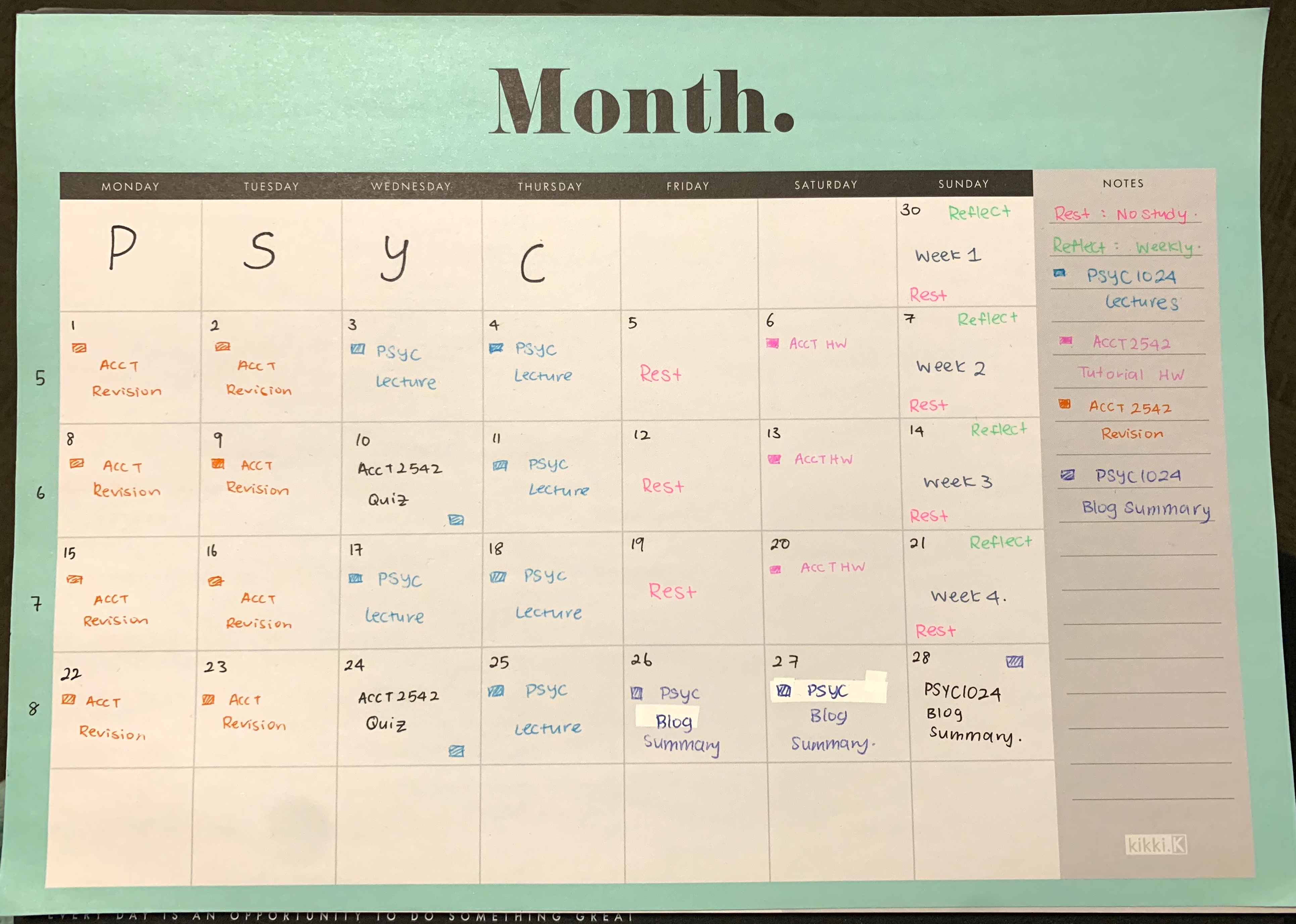
In week 1, I would be focusing on fulfilling my SMART goals and keeping up on lectures for the week. In week 2, I would be putting focus on revision for a mid-week quiz I have for an accounting module I am taking. During week 3, I would shift back to ensuring I am up to date on tutorials and lectures. On week 4, I would be putting focus on both my blog summary and another mid-week test for my accounting module. Week 3 and 4 may require me to be putting in more hours in order to ensure that I maintain my low level of stress and anxiety to be meeting my due dates on time.
Every Sunday of the week, I would be filling out the Perceived Stress Scale as well as recording down a reflection for the week, this would allow me to easily track my progress in terms of my stress and anxiety levels, and would allow easy comparison between each weeks. It would also allow me to reflect on whether I was able to follow my planned schedules, whether anything could be improved or adjusted or if there were any unforeseen circumstances.

 PSYC1024 Rachel Lee